

If you’ve ever opened a pool cover to find cloudy green water after weeks of neglect, you already understand why swimming pool cleaning isn’t something you can do once a month and forget about. A pool is a living chemical and biological system — algae, bacteria, minerals, and debris are constantly working against the clarity you’re trying to maintain, and the gap between “well-kept” and “expensive problem” is often just a week or two of skipped basics.
This guide walks through what actually matters in pool cleaning, separating the daily habits from the deeper maintenance tasks that most owners either overdo or, more commonly, put off until the water turns.
Daily and Weekly Cleaning Tasks
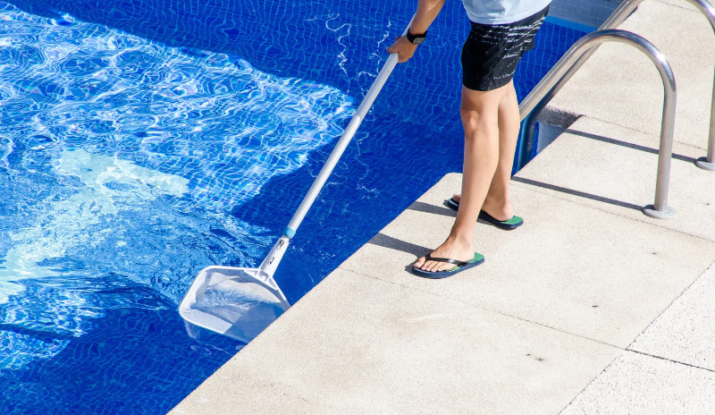
The single most effective habit in pool care is also the simplest: skimming the surface before debris sinks. Leaves, insects, and pollen that stay on the surface for more than a day tend to break down and release organic material that feeds algae. A net pass every morning, or every other day at minimum, prevents a cascade of bigger problems later.
Beyond skimming, three tasks form the weekly baseline:
- Brushing the walls and floor to prevent algae from taking hold in textured surfaces, particularly in corners, steps, and around fittings where circulation is weakest.
- Emptying skimmer and pump baskets, since a clogged basket reduces circulation and forces your pump to work harder than it needs to.
- Vacuuming either manually or with an automatic cleaner, targeting sediment that skimming alone won’t catch.
Skipping any one of these for a week is rarely catastrophic. Skipping all three consistently is how a clear pool turns cloudy within a season.
Water Chemistry: The Part Most People Get Wrong
Cleaning the surface and vacuuming debris only solves half the problem. The other half is chemical, and it’s where most DIY pool maintenance goes wrong — usually through inconsistency rather than ignorance.
“Most cloudy pool complaints we get called out for aren’t dirt at all — they’re chemistry that’s drifted for two or three weeks without anyone testing it.”MAZAYA facilities maintenance team
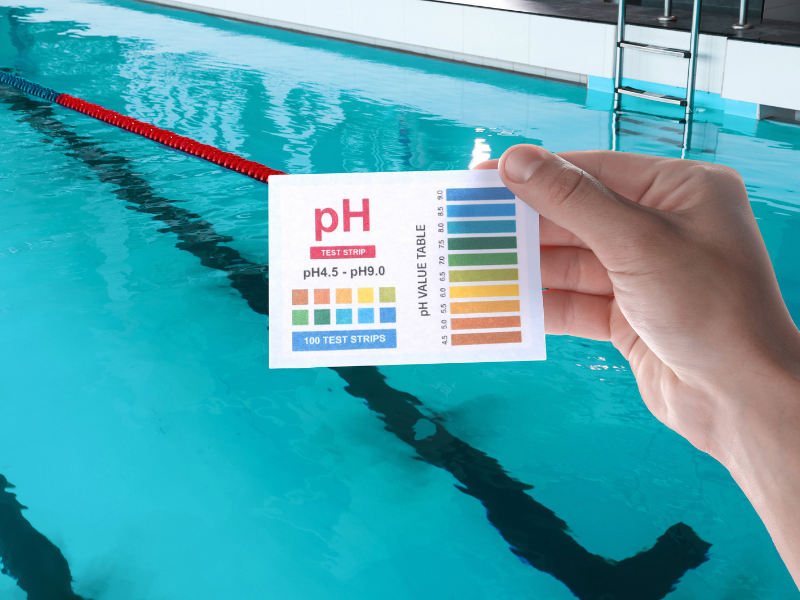
The core numbers to track are pH (ideally between 7.2 and 7.6), free chlorine or an equivalent sanitizer level, and total alkalinity, which acts as a buffer that keeps pH from swinging wildly. Testing twice a week during heavy-use months, and once a week in quieter periods, catches problems while they’re still cheap to fix with a small chemical adjustment rather than a full shock treatment.
Calcium hardness and stabilizer (cyanuric acid) levels matter too, but they drift more slowly and typically only need checking monthly. Where owners run into trouble is treating chemistry as a one-time setup rather than an ongoing balance — water evaporates, rain dilutes, sunlight burns off chlorine, and every swimmer introduces oils, sunscreen, and bacteria that shift the numbers slightly each time.
Shock Treatment: When and Why
Shocking a pool — adding a large dose of chlorine or non-chlorine oxidizer — isn’t a routine weekly task, despite how often it’s marketed that way. It’s meant for specific situations: after heavy rain, after a large swimming event, when chloramine odor becomes noticeable, or when algae has already started to bloom. Shocking a healthy, well-maintained pool on a fixed weekly schedule regardless of actual need tends to waste chemicals and, over time, can push stabilizer levels too high.
Filtration: The System Doing the Invisible Work
Skimming and brushing handle what you can see. Your filter handles what you can’t, and it’s the piece of equipment most likely to be neglected because its condition isn’t visually obvious the way murky water is.
Sand filters typically need backwashing every one to four weeks depending on bather load and debris. Cartridge filters should be rinsed regularly and deep-cleaned with a filter cleaner solution every few months. Diatomaceous earth (DE) filters need backwashing plus periodic recharging with fresh DE powder. Whatever type you have, running the pump long enough each day — generally 8 to 12 hours during swim season — matters as much as the filter media itself, since water that isn’t circulating isn’t being filtered, no matter how clean the equipment is.
Seasonal and Structural Maintenance
Beyond the routine, a few tasks happen on a longer cycle but carry outsized consequences if ignored. Tile lines should be scrubbed periodically to prevent calcium buildup, which is far easier to remove early than after it’s calcified over a season. Grout, coping, and any surrounding stonework benefit from an annual inspection, since cracks here often let water seep into structural areas that are expensive to repair once damage sets in.
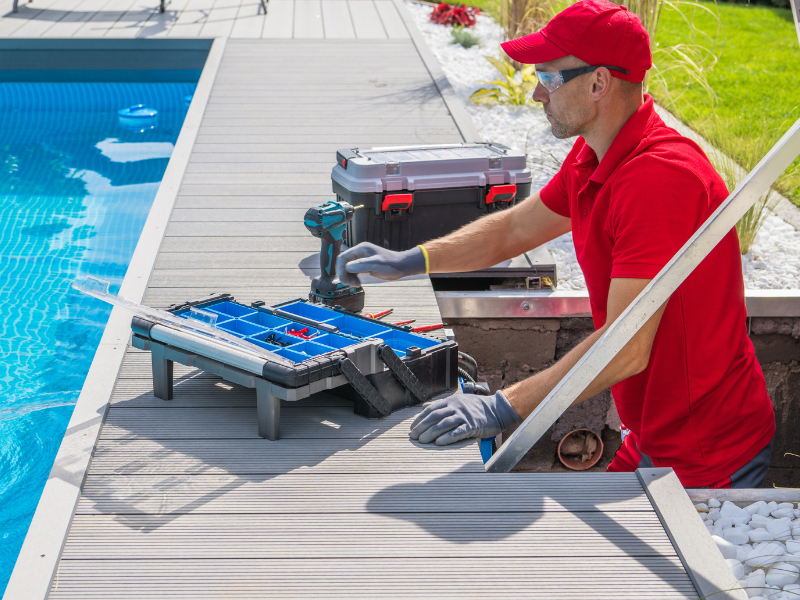
Pool covers, when used, need their own cleaning schedule — a dirty cover defeats much of its purpose by shedding debris back into the water every time it’s removed. And for anyone managing a pool as part of a larger property — a villa, a boutique hotel, a residential complex — coordinating pool maintenance with broader facility upkeep (drainage, electrical safety for pumps, structural inspection) tends to catch problems that a pool-only routine misses entirely.
This is where a broader facilities approach earns its keep. MAZAYA handles pool maintenance as part of integrated property care rather than as an isolated task, which means chemistry, filtration, and structural checks get scheduled together instead of independently, often catching issues — a failing pump, a cracked liner — before they become the kind of problem that empties a pool entirely.
Getting Ahead of the Problems Before They Start
Most pool problems trace back to inconsistency rather than a single mistake — a skipped week of testing, a basket that goes unemptied, a filter that runs past its service interval. The good news is that none of it requires expert-level knowledge, just a routine that doesn’t lapse for more than a week or two at a time.
For property owners who’d rather hand this off entirely, MAZAYA offers dedicated maintenance plans that combine pool care with the rest of a property’s technical upkeep — explore MAZAYA’s comprehensive solutions through our services page, or book an appointment to have a technician assess your current setup. You can also see examples of past maintenance work in our portfolio, or reach out directly via our contact page with questions.
Keeping a pool genuinely clean isn’t about occasional deep cleans — it’s about small, consistent habits that never let the water drift far enough to need one. For more property maintenance guides like this, visit MAZAYA.Pro or browse our blog.
Comments (2)
Priya Sharma
Good callout on shocking not being a routine weekly thing. Our previous pool guy had us shocking every Sunday regardless, and our stabilizer levels crept up for months before we figured out why the chlorine stopped working as well.
Daniel Okafor
The chemistry point hit home — I used to only check pH when the water already looked off, which of course meant I was always a week behind. Switched to twice-weekly testing this summer and haven’t had a single cloudy spell since.